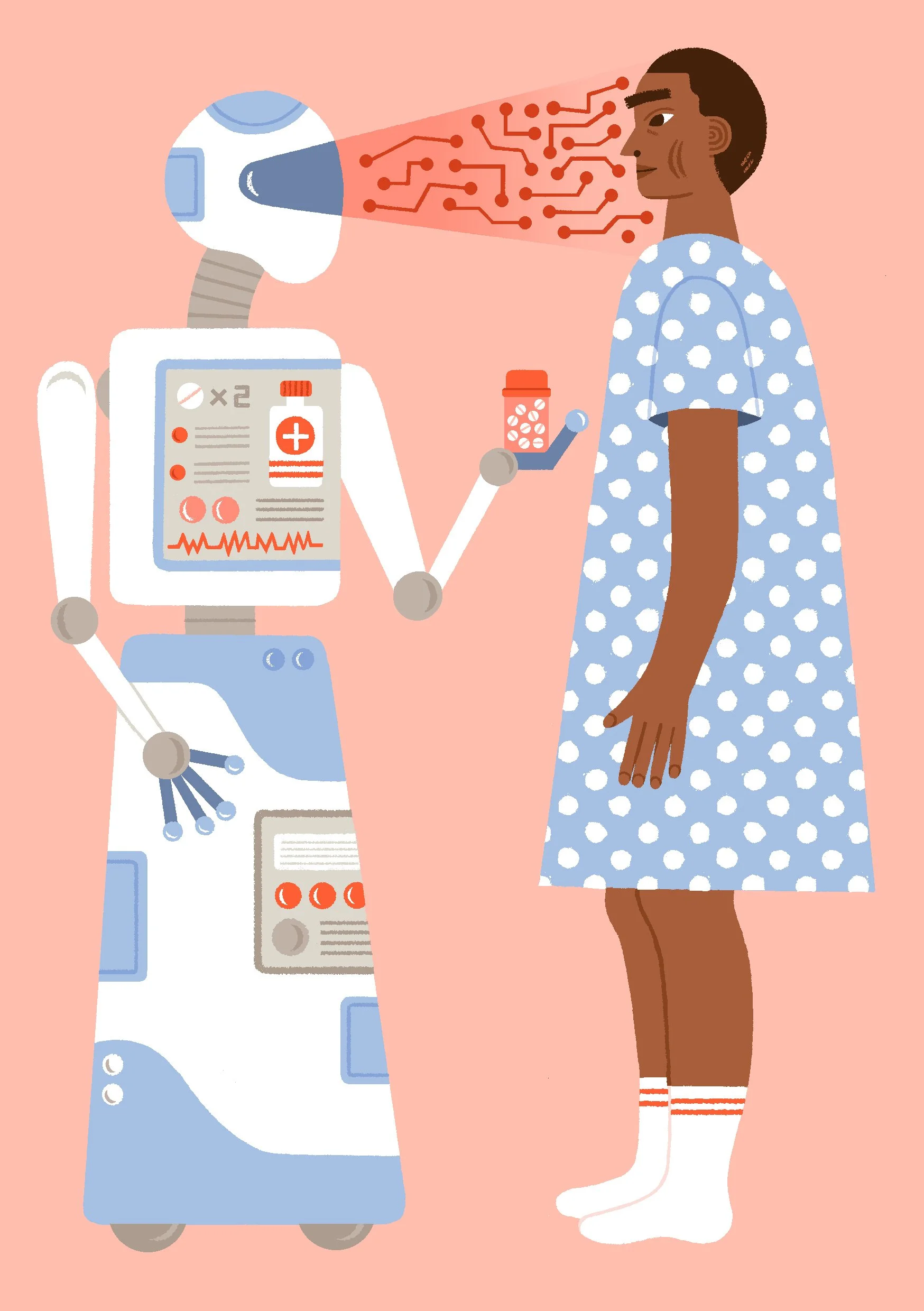
I’ve been to quite a few doctors' appointments over the last ten years. In fact, I wrote about turning to Google ten years ago when I was diagnosed with Crohn’s disease. Until I got my official diagnosis, I spent what felt like all of my waking hours googling symptoms, wondering what’s wrong with me, and trying to navigate a disease that isn’t necessarily “seen” on the outside, but is most definitely felt on the inside.
Ten years ago, turning to Dr. Google felt cutting-edge. I could hunt for medical papers. I could look up questions about my period. I could dabble in piecing together a lifestyle I thought would benefit me, according to the bible of Google.
Back then, scrolling through endless Google search results felt powerful. Disconnected and impersonal, but powerful.
This was my usual process regarding doctor appointments:
Google symptom
Jot down info to share with the doctor
Make a doc appointment
Get to appt
Remember all of the symptoms to share
Understand that the doctor has limited time to spend with you
Forgot to mention something
Leave appointment
Take the directive to make an appointment with a specialist
Figure out which portal the information lies in
Go in for bloodwork
Get results
Try to decipher the results until a nurse calls
Spend hours Googling
Rinse and repeat
Yes, that process, back allllll the way in 2016, I thought was groundbreaking.
Knowledge at my fingertips!
Answers! (or something close to an answer that was found on page 8 of the Google results).
But here is something 2016 Google couldn't do: Take in my disparate data and output something useful that I can actually work with.
*Disparate data is data that is scattered everywhere - like when you took your blood pressure and jotted the results down on a napkin, or the letter with your allergy test results that you are using as a bookmark or when your information is spread across numerous institutions, states, offices and checkboxes.
Now, before I go any further, it is important to note that along with my numerous doctor appointments, I also have health anxiety. Maybe even a tad bit of undiagnosed ADHD. Add in managing the healthcare of my kids (just got over an ear infection and hand, foot, mouth) and a husband who is also taking hold of his health as we get older (hello late 30s!) and yeah…I've turned to Google more than once.
Google helped me navigate the last 10 years with a Crohn’s diagnosis, my first pregnancy, postpartum pre-eclampsia, postpartum anxiety, miscarriage, a second pregnancy, invisible body pain, no answers, a scattered brain, and now entering an era of…perimenopause?
My body is entering a new era, and so is my approach to healthcare. This time around, I use AI more than Google.
Let me explain. In 2022, AI went mainstream. Or rather, LLMs went mainstream (that's a large language model - so ChatGPT, Claude, Perplexity, Gemini - take your pick!). I could ask anything and get an immediate result. But then AI got better…and better.
As AI capabilities progressed, I was able to utilize:
Better memory - (my AI remembers what month my last scan was, the results, and how I was feeling at the time)
Deep research - When was Crohn’s “discovered”? What other diseases does it resemble? How has Crohn’s and pregnancy been handled historically? How does Crohn’s differ in the US vs. other countries?
Personalization - If I want to take a new vitamin/supplement, I just take a picture, upload it, and ask about it. My AI remembers the brands I like, how I like to buy “clean” if possible, and my city. It will ask whether I want a suggestion for online vs. a neighborhood drugstore, and at what price point.
AI has been amazing for my own research and staying informed, but that doesn't mean the technology is perfect.
It isn’t. But it does help me feel more in control of both my health and my ability to communicate with doctors and nurses. It has completely changed how I approach health, work, and so much more. BUT, and this is a big but - AI also has risks.
AI still hallucinates (when it makes things up or shares inaccurate information).
Your information is never really “private”. If you were sued and your prompt history came up in court, it can be used against you.
We don't really know what the future holds. Will we always have equal access? Will compliance and regulation protocols change as the tech evolves and AI becomes more deeply ingrained in the healthcare system?
If I'm being completely honest, all of this is new and feels extremely sci-fi at times. I fear that insurance companies will one day be able to use prompt history to decide whether a condition was, in fact, “pre-existing”. Its scary to think about.
But I'm also excited for a future of ease (imagine seeing a dermatologist and them asking how long you have had a mole. You don't know. But you can have AI assess the pictures in your phone over the last few years and tell you exactly when the mole showed up - it made an appearance in a photo from a vacation to California 6 months ago. How huge would that be?
So while I am not saying you should rush and enter all your sensitive data into an AI tool (remember, NO LLM is HIPAA-compliant in and of itself), I do think using AI to help decipher information is beneficial.
One day, AI in healthcare will be exactly what we need it to be. And in a perfect world, it would still be private and compliant.
And maybe, just maybe, this AI race will lead the US to universal healthcare. Because, sure, AI can help fix healthcare…or it can radically overhaul the system to truly make healthcare accessible for everyone.
Audio Narration Coming Soon
Shalirrah Wisney’s world is a blend of parenting, writing, marketing and AI. She is the author of the children's book Hello, AI Helpers, which explores the invisible, helpful presence of AI “helpers” in our daily lives. When she isn’t writing or planning, she hosts the podcast AI on the Side.
Connect with Shalirrah and catch her latest insights on TikTok.
Cover Photo: Noa Snir